Test your strategy before the future does.
We expose your company to artificially generated futures and measure where it holds and where it breaks.
Is your company, in its present condition, prepared for the future?
Every company has an answer to this question. It is usually worth little, for three reasons: it comes from inside the house — the same people who made the strategy judge how durable it is. It starts from the present — the plan is checked against today's world, not against the worlds of tomorrow. And it is never tested — until reality runs the test.
The wind tunnel in three minutes.
How environmental scanning turns into worlds of the future — and how a strategy in the wind tunnel shows where it holds and where it separates.
German narration, English subtitles.
The most expensive test is the one reality runs.
Strategies are planned against a future nobody knows. Planning extrapolates the present — the future rarely cooperates.
Stress tests stay thought experiments. "What if" gets discussed, not measured — and ends where one's own imagination ends.
The correction arrives when it is expensive. What is an assumption on paper today is a factory, a contract, a missed position in five years.
A SWOT in which the outside is no longer guessed.
Classically, the inside is assessed with care — and the outside is compiled in a workshop: a snapshot plus gut feeling, outdated before the measures are approved. Here, the outside is machine-generated, continuously updated, and available in several consistent variants.
What is moving in the environment
Continuous monitoring of signals, trends and shifts across six STEEP dimensions — by machine, around the clock, not as an annual study.
Powered by squawk.de
Several consistent variants
From the environmental factors, consistency-checked future worlds are generated — not one forecast, but the space in which the future can plausibly move.
Powered by picturesoftomorrow.com
The company profile
Business model, resources, dependencies — and the assumptions everything rests on, made explicit and phrased so they can be tested.
Captured in the review, with you
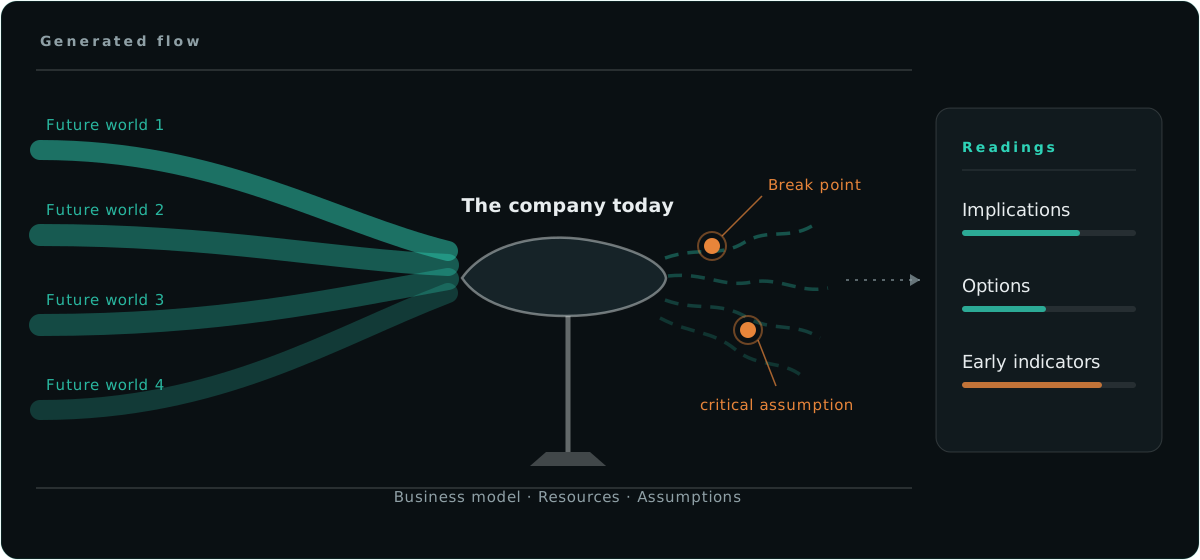
Matching the three is the wind tunnel.
The fit is not checked against the future but against several — and the differences are the result.
Measure, don't opine.
The flow is generated, not awaited.
In a wind tunnel, nobody waits for wind. Here, futures are generated by machine: consistent future worlds from the scenario engine, fed by continuous environmental monitoring.
A model is mounted, not the original.
No company can test its strategy in reality — the bill arrives years later. In the wind tunnel, the error is cheap. The model is the company profile: business model, resources, dependencies, assumptions.
It is measured, not debated.
Not "we consider this robust", but: where does the flow separate? Where does turbulence form? Which assumption underneath the business model does not hold?
Variants become comparable.
Same tunnel, different configuration — strategic options become measurable against each other instead of being asserted against each other.
Click to enlarge. More on the method: How the wind tunnel works.
Five steps. Weeks, not months.
-
Sharpen the guiding questionTime horizon, system boundary, decision link
You provideThe decision at hand and the period it concerns.
You receiveA precisely phrased guiding question the whole run hangs on.
-
Capture the company profileBusiness model, resources, dependencies, assumptions
You provideOne structured conversation and existing documents — nothing more.
You receiveThe model to be mounted: your company, including its assumptions sheet.
-
Generate future worldsEnvironmental factors, scenarios, consistency check
You provideNothing — this is machine work.
You receiveSeveral consistent future worlds for your time horizon, derived traceably.
-
Run in the wind tunnelMatch per future world, break points, load tests
You provideAccess for queries: short clarifications where the profile shows gaps.
You receiveThe measured fit per future world — including the places where it breaks.
-
Decision briefImplications, options, early indicators
You provideOne meeting with the people who decide.
You receiveA brief you can decide with — not a slide deck for the archive.
Time frame of a review: weeks, not months. The machines work continuously; the bottleneck is your calendar.
What the decision brief contains.
Implications per future world
What each world concretely means for your business model, market and resources — world by world, side by side.
Strategic options with assessment
Which options hold in which worlds — and which only work in a single one.
Break points and critical assumptions
The places where the flow separates: assumptions that do not hold in all worlds — named, substantiated, prioritized.
Early indicators to keep watching
What reveals early which direction the world is actually taking — ready to plug into continuous monitoring.
Method figures — not promises.
Who comes with which question.
Executives and heads of strategy
Does the strategy we are about to approve hold outside our planning scenario?
Supervisory and advisory boards
Which untested assumptions does the plan we are asked to approve rest on?
Investment and holding companies
How future-proof is this company's business model — before entry, before exit?
Heads of innovation and technology
In which future worlds does our portfolio hold — and where is an option missing?
Part of a larger system.
The Strategy Review is one building block of Flipped Foresight — a foresight system that inverts the classic division of roles: machines monitor the environment and generate futures, continuously and at breadth; humans judge, focus and decide. The wind tunnel is where the two meet — where generated futures become tested decisions.
Request a review.
No form backend, no third-party service: your entries become a pre-drafted email that opens in your own mail client. Nothing is sent until you send it.
Directly by email: info@operation-zukunft.de